Drone Production - Warfare
These drones are the future of warfare. Drone technology will be a cash cow in the 21st century.
Here is a summary of the video in case you do not want to watch the whole thing.
This report goes inside a private Ukrainian drone manufacturing facility operated by engineer Andrii Malyshev.
Summary
Shifting Dynamics of the War: The report highlights how traditional warfare methods (tanks, artillery, aviation) are being largely replaced or supplemented by drones, which act as artillery, mortar units, and infantry strikes at a fraction of the cost.
Production Operations & Scale:
Started as a small effort with military assistance in mind, Andrii Malyshev's startup now employs around 25 people and has a capacity to produce up to 3,000 drones per month.
The factory builds various models, including 10-inch and 13-inch single-use FPV kamikaze drones, as well as reusable bombers, logistics carriers, and thermal-capable reconnaissance drones.
They also offer maintenance and repair services based directly on soldier feedback from the front lines.
Shift to Domestic Components:
Ukraine is heavily pushing to replace Chinese components due to supply constraints and geopolitical friction.
The factory now manufactures its own duralumin metal frames (e.g., the Iron Kite frame) and utilizes domestic Ukrainian-made flight controllers and speed controllers.
Electric motors are still primarily imported from China due to a lack of domestic small-motor production.
Advanced Features & Innovations:
Drones are customized with features like dual camera setups (switching between daytime and thermal cameras mid-flight) and signal boosters.
Experimental models feature mounted anti-tank grenade launchers, as well as interceptor drones capable of taking down Russian Zala reconnaissance UAVs in mid-air.
Newer units use vision-based autonomous navigation that matches real-time ground imagery to onboard maps, allowing operation without GPS and rendering them resistant to electronic warfare jamming.
Call for Continued Global Support: The facility’s team emphasizes that drone development is an ongoing race against Russian mass production. They stress the urgent need for continuous technological support, components, and international aid to save lives on the front line.
Drones are going to be a huge cash cow in the coming years. After the dust has settled in the Ukraine/Russian war and after the Iran/US war has run its course I think militaries from these countries and around the world will be retooling their arsenals. Companies like the one above will be uniquely positioned to lead the way in the new age of warfare. I read where the USA is currently producing 300,000 drones per year, that is peanuts compared to what Ukraine is producing which is 7,000,000. A talented STEM major with a background is technology or a VC/Private equity firm is in a unique time in history if they see the potential to acquire a company like this or to work with them on bringing production expertise and capacity to their home country.
There is something in business called veridical integration. Vertical integration is a strategy where a company owns or controls multiple stages of its production supply chain rather than relying on external suppliers and distributors. In the video they talk about replacing Chinse components with components produced in Ukraine. They talk about producing their own frame. They talk about using Ukrainian circuit boards vs Chinese made circuit boards. All of this I just mentioned goes into owning/controlling stages in the production supply chain. You are not constrained if the external country decides to not sell you anymore parts, you are not constrained by long lead times for shipments, you control more or all of the production components necessary.
Who Are The Buyers Of These Drones?
Defense Ministries
State/Sovereign Buyers (Middle Eastern countries, the Caucuses, European countries, Asian countries)
Law Enforcement Agencies (Federal and local departments)
Private Militaries/Defense Contractors
Critical Infrastructure/Enterprise Operators (Nuclear plants, oil refineries, electrical grid substations, airports, stadiums, data centers, correctional facilities)
Low Cost Solution. High Value Punch.
You cannot use $1 million to $4 million interceptors to take out a $20,000 drone. It is not economical and if that is how you are operating in the 21st century warfare space you are behind the 8 ball. One of these cheap drones could make your tank, your ship, your vehicle unusable. You need viable economic solutions in todays battlefield. Below is a summary of the video in case you do not want to watch it.
Summary
Extreme Asymmetric Economics
Cost Efficiency: A single civilian or racing first-person view (FPV) drone costs around $500, yet it can disable or destroy a $3 million tank or multi-million-dollar warship.
Attritional Warfare: Long-range drones like Terminal Autonomy’s AQ 400 Scythe sell for ~$30,000, using simple components like dishwasher chips. If shot down, it remains an economic win for Ukraine because the intercepting missile costs substantially more than the drone itself.
Grassroots Defense Industry & Fast Development
Underground Factories & Startups: Ukraine has over 100 underground drone manufacturing hubs run by tech entrepreneurs, engineers, and volunteers.
Rapid Innovation Loop: Feedback from frontline soldiers to technicians allows for a "kill chain" from manufacturing to combat deployment of less than one week.
Local Production: Producers are reducing reliance on Chinese components by manufacturing localized frames, propellers, and specialized dropping mechanisms on 3D printers.
Technology & Battlefield Evolution
FPV Kamikaze Drones: Standard racing drones flying up to 100 mph carrying attached explosives act as lethal precision strikes.
Night-time Heavy Bombers: Drones like the Vampire (dubbed "Baba Yaga" by Russian forces) carry large explosives and employ thermal imaging to attack targets at night.
Adapting to Electronic Warfare: Ukrainian volunteer groups like Dronomania reverse-engineer captured Russian equipment to boost transmitter power and build custom signal antennas to bypass jamming.
Strategic Impact & Current Challenges
Targeting Russian Infrastructure: Autonomous long-range strike drones have been deployed deeply into Russian territory to attack oil refineries and supply lines.
Filling Aid Gaps: Low-cost drones proved essential in holding back Russian advances during periods when Western military aid was delayed or blocked in Congress.
Scalability Limitations: Russia has scaled up its own drone manufacturing and imported Iranian-designed Shahed drones, leaving Ukraine competing against a massive industrial opponent.
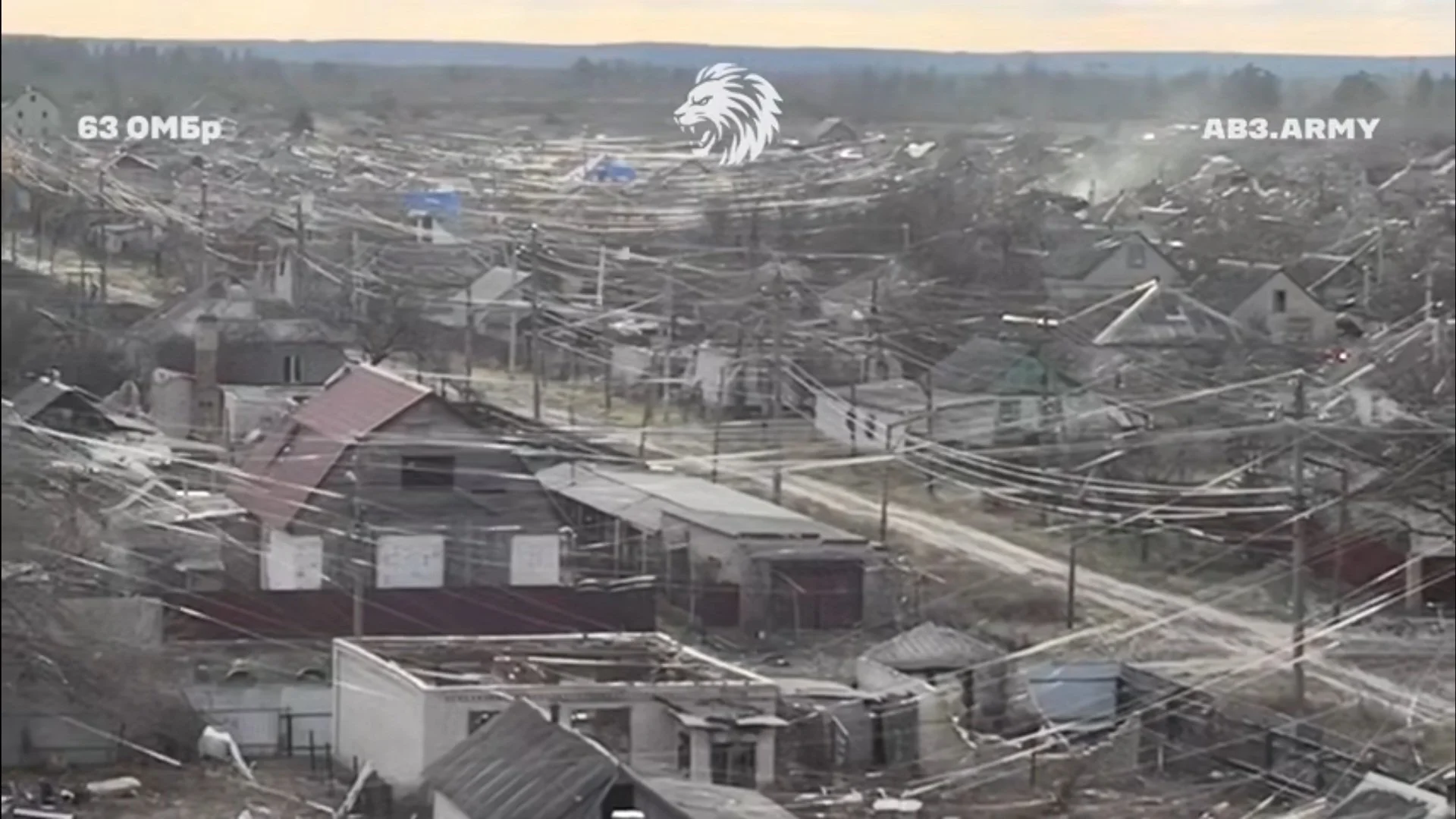
Fiber optic spiderwebs in Ukraine. (the modern battlefield)