Series: “The Business of Cartels” - Part 4: Corruption & Complicity
The Business of Cartels
Part 4: Corruption & Complicity
Every part of this series so far has treated cartels as businesses. This part treats them as something closer to shadow governments, because that's what a lot of them actually become in the territory they control. Guns and money get most of the attention in cartel coverage, but corruption is the part of the story that explains how these organizations actually survive decade after decade, arrest after arrest, president after president. A cartel doesn't beat the state through firepower alone. It usually just buys enough of the state that fighting back stops being in anyone's interest.
Plata o Plomo
The phrase that captures this best is plata o plomo, silver or lead. Take the bribe, or take the bullet. It's often described as an offer, but it's really closer to a business proposition dressed up as a threat. A police commander, a judge, a customs official, a mayor, all of them have a price, and cartels have gotten very good at figuring out what that price is. Refuse the money and the alternative is the bullet. What makes this dynamic so durable isn't the threat itself. It's that taking the money is usually the rational choice for the person being offered it. A local police officer earning a modest government salary, with a family and a mortgage, is being asked to risk his life enforcing laws against an organization that can kill him, his family, or both, with near total impunity in a lot of the regions where cartels operate. The bribe isn't corrupting an otherwise functional system so much as it's exploiting a system that was already too weak, too underpaid, and too unprotected to resist in the first place.


The García Luna Case
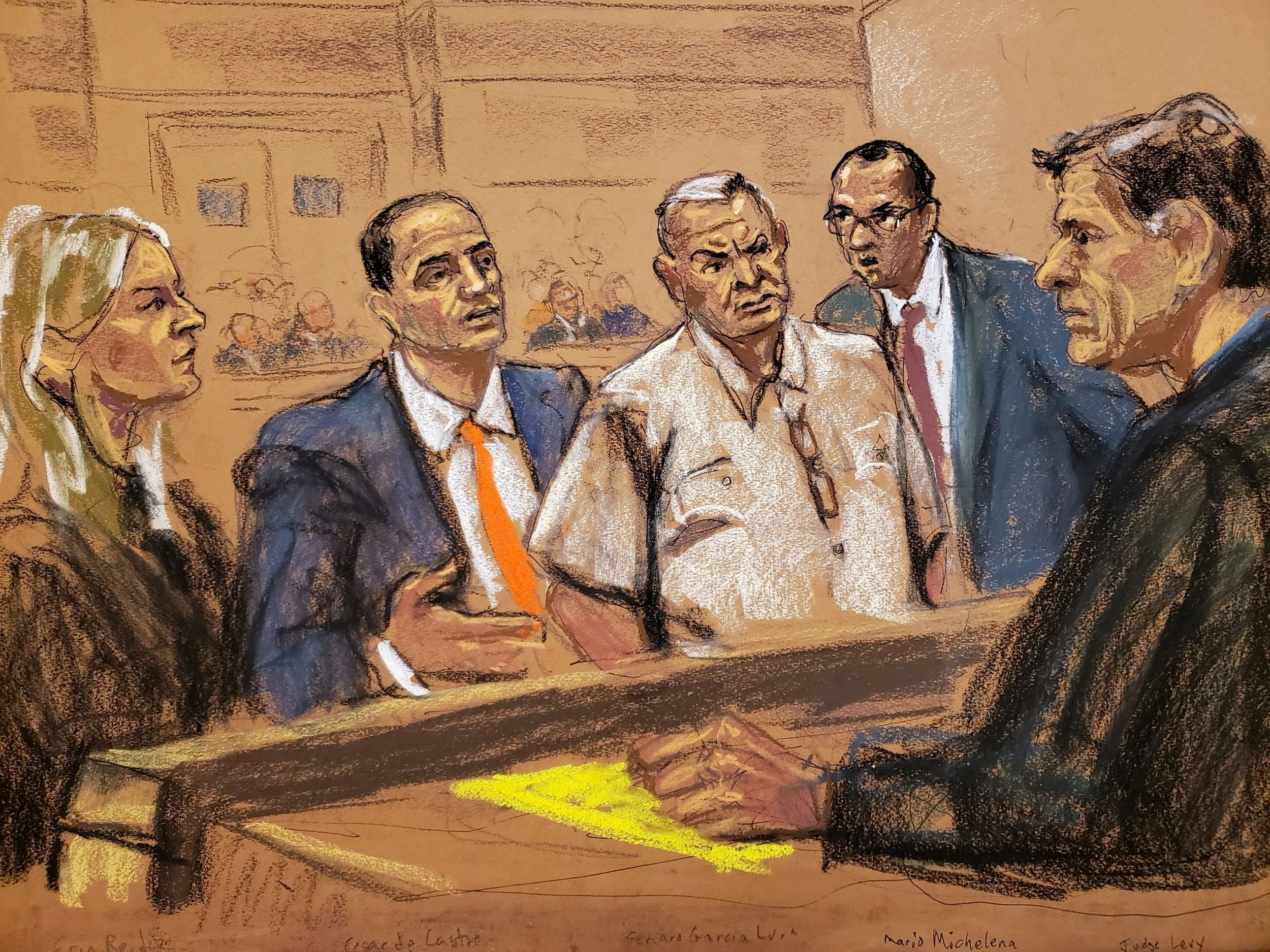
For decades, corruption stories mostly stayed at the level of a bribed local cop or a mayor on the payroll. Then, in February 2023, a New York jury convicted Genaro García Luna, Mexico's former Secretary of Public Security, of taking bribes from the Sinaloa Cartel while he was the man officially in charge of fighting it. García Luna ran Mexico's federal police and later its entire security apparatus from 2001 to 2012, making him the highest-ranking government official from either side of the border to be tried and convicted in the United States for cartel corruption. Prosecutors laid out a case built on testimony that Sinaloa Cartel members delivered millions of dollars to him in briefcases, in exchange for protection and, according to witnesses, advance warning of law enforcement operations against the cartel and its rivals. He wasn't a rogue cop taking a payoff to look the other way on a single shipment. He was the architect of Mexico's entire war on drugs, at the same time he was reportedly on the payroll of the organization that war was supposed to be fighting. The case also aired testimony, secondhand and disputed, alleging that former Mexican President Felipe Calderón had sought to protect Guzmán's organization against a rival cartel. Calderón denied it outright, calling the claim absurd, and it was never proven in court. Whether or not that specific allegation holds up, its mere presence at trial says something about how far up a cartel's reach can plausibly extend, and how hard it becomes to draw a clean line between "the state" and "the organization it's supposedly fighting" once corruption goes deep enough.
Colombia's Parapolitics Scandal
Mexico isn't the only country where this pattern shows up, and cartels aren't the only armed groups that buy political protection. Colombia went through its own version of the same problem in the mid-2000s, involving the right-wing paramilitary umbrella group AUC rather than a drug cartel in the strict sense, though the AUC funded much of its operation through the same cocaine trade that built Medellín and Cali.
In 2005, a paramilitary leader named Vicente Castaño told a Colombian magazine that his organization counted roughly 35 percent of Congress as friends. That single line set off an investigation that's still producing convictions today. A laptop seized from a demobilized paramilitary commander known as Jorge 40 turned out to contain signed pacts between paramilitary leaders and sitting politicians, agreements to help candidates win office in exchange for those candidates defending paramilitary interests once elected. By 2019, more than 60 members of Congress and seven governors had been convicted for using paramilitary intimidation and money to win their seats, and investigations had reached more than 11,000 Colombians, including business figures and, at least by accusation, former president Álvaro Uribe himself, who has faced but never been formally charged with allegations tying him to both the Medellín Cartel and the AUC. Colombia's own intelligence agency, DAS, was drawn into the scandal too, after leaks showed it had worked directly with AUC paramilitaries while also wiretapping the Supreme Court justices investigating the case.
Parapolitics is a useful comparison to García Luna because it shows the same dynamic operating at a completely different scale. García Luna was one extraordinarily well-placed official. Colombia's scandal implicated a meaningful share of an entire national legislature, over multiple election cycles, suggesting that in some periods a criminal organization wasn't just bribing the state from the outside. It was helping to elect the people who ran it.

Governing the Gaps the State Leaves Behind
Bribery explains how cartels protect their operations. It doesn't fully explain why so many communities in cartel-controlled territory don't turn against them, and the answer to that has more to do with what a cartel provides than what it threatens. In places where the government has never reliably delivered basic services, paved roads, functioning schools, jobs, physical security, a cartel with money and an interest in local stability can step into that vacuum. Pablo Escobar's housing and soccer-field spending in Medellín, covered in Part 1, is the clearest early example, but the pattern has repeated in Mexico for decades since. Some organizations fund clinics, sponsor local festivals, or hand out cash and food during disasters and holidays, all of it calculated to buy the kind of goodwill that keeps a community from cooperating with police or the military. Where a cartel effectively controls the local economy, whether through legitimate businesses it owns, extortion of the ones it doesn't, or direct employment of a meaningful share of local men, it becomes, in practical terms, the most reliable employer and social safety net many residents have ever had access to.
This is what makes the "complicity" in this part's title broader than just corrupt officials taking bribes. A whole local economy can become dependent on a cartel's presence, drivers, lookouts, laborers on cartel-linked farms or mines, shopkeepers paying protection money who'd rather pay it than see the alternative, families receiving cash gifts, without any individual necessarily seeing themselves as part of a criminal enterprise. The state's absence is what creates the space cartels fill, and once they've filled it, dislodging them means asking a community to give up the only functioning institution it has, in exchange for a promise that the government will show up and do better. That promise doesn't have a great track record.
Why This Part of the Story Gets Underreported
Coverage of cartels tends to gravitate toward violence, because violence is visible, dramatic, and easy to put on camera. A beheading or a shootout generates headlines. A police captain quietly taking a monthly payment, or a mayor's office steering contracts to a cartel-linked construction company, generates almost none, even though the second kind of story is arguably more important to understanding why the first kind keeps happening. Corruption is also just harder to report. It requires financial records, court testimony, or a whistleblower willing to risk their life, rather than a body count that speaks for itself. The García Luna conviction only happened because U.S. prosecutors had subpoena power, cooperating witnesses inside the Sinaloa Cartel's own operation, and years to build the case, resources that don't exist for most local corruption inside Mexico or Colombia. For every García Luna who gets caught and tried in a country with the institutional capacity to do it, there are almost certainly a much larger number of officials at every level of government whose arrangements with organized crime never make it anywhere near a courtroom.
That gap, between how much corruption almost certainly exists and how little of it ever gets prosecuted, is really the underlying subject of this entire part. The War on Drugs has spent decades treating cartels as an external threat to be fought with police and soldiers. In a lot of the regions where these organizations operate, that framing has never been accurate. The cartel isn't always outside the state, working against it. In enough cases to matter, it's inside the state, working through it. Part 5 looks at what that fifty-year war has actually cost, in lives and in policy failures, and asks whether the strategy built on treating cartels purely as an outside enemy was ever aimed at the right target.
Works Cited
"Mexico's Ex-Security Chief Convicted of Bribery, Protecting Drug Cartels." Associated Press, 21 Feb. 2023, abcnews4.com/news/nation-world/mexicos-ex-security-chief-convicted-of-bribery-protecting-drug-cartels-public-security-genaro-garca-luna-war-on-drugs-sinaloa-cartel-el-chapo-andrs-manuel-lpez-obrador-felipe-caldern-narcos.
"Genaro García Luna: Mexico's Ex-Security Minister Convicted of Bribes and Drug Smuggling." AFP, 21 Feb. 2023, ca.news.yahoo.com/genaro-garc-luna-mexico-ex-221428854.html.
"Mexico's Former Top Security Official Convicted in Cartel Bribery Case." Denver7, 21 Feb. 2023, denver7.com/news/national/mexicos-former-top-security-official-convicted-in-cartel-bribery-case.
"Parapolitics." Colombia Reports, 22 May 2019, colombiareports.com/parapolitics/.
Volckhausen, Taran. "45 Colombian Congress Members Convicted over Paramilitary Ties since 2006." Colombia Reports, 10 Dec. 2013, colombiareports.com/colombia-congress-members-convicted-parapolitics/.
"37 Colombian Congressmen, 5 Governors Convicted for Ties to Paramilitaries." Colombia Reports, 16 May 2012, colombiareports.com/?p=22288.
"Colombia State Ties to Paramilitary Groups Alive and Well: Report." Colombia Reports, 19 Apr. 2016, colombiareports.com/paramilitary-links-still-present-colombia-politics-report/.
Extra: Quote and Video
"The thing that scared me the most while reporting that story is we're not just talking about drugs on our streets, we're talking about the corruption of our government." - Mariana van Zeller